





Patrols, Proven: How AI-Powered MMS Patrol Changes the Defensibility Equation for Ontario Municipalities
If you run patrol for an Ontario municipality, you already know the uncomfortable truth: O. Reg. 239/02 doesn’t just ask you to do patrols. It asks you to prove you did them, years after the fact, in front of a lawyer, under discovery. And that distinction, between doing the work and proving it, is where most patrol programs quietly fail.
This post walks through why that gap is widening, what a defensible patrol record actually has to contain, and how purpose-built mobile and AI tools are reshaping what compliance, field workflow, and council reporting can look like.
Three pressures converging this year
Three forces are pushing patrol programs into the spotlight all at once.
The first is litigation. Slip-and-fall and vehicle claims are trending up across Ontario, and discovery demands have become more aggressive. Paper records, with missing times, illegible handwriting, and lost binders, increasingly fail the defensibility test when they’re scrutinized in court.
The second is staff turnover. Patrol programs built on individual memory don’t survive a retirement, let alone a lawsuit three years later. When the patroller who knew the route is gone, so is the institutional knowledge that made the records make sense.
The third is the data you’re not capturing. Your trucks already cover the network every week. Without AI in the cab, that’s millions of frames of pavement and asset condition data driving past you and disappearing.
O. Reg. 239/02
The Ontario Minimum Maintenance Standards give municipalities a statutory defense to highway maintenance claims, but only if the standard is met and documented. Patrol is the foundation of that defense.
Frequencies are tiered by highway class: three times a week for Class 1, twice a week for Class 2, weekly for Class 3, every two weeks for Class 4, monthly for Class 5, and not required for Class 6. Winter conditions trigger separate, often shorter cycles. And those numbers are a floor, not a ceiling. Defensibility is what your records actually show happened on each patrol.
What a defensible patrol record requires
Six elements have to be on every record a lawyer will want to see:
Who patrolled: identifiable and accountable. When: date and time captured at the point of observation, not reconstructed at the end of the shift. Where: route and segments backed by GPS coverage, not a scrawled street name. Conditions: what was observed, with enough specificity to reconstruct later. Actions: what was done, including work orders initiated and advisories posted. Retention: records preserved tamper-evident for the required period.
Miss one element and the record weakens. Miss two and you’re in trouble.
Where paper and spreadsheets fail
The honest version: paper holds up until the day it doesn’t. Times get skipped or rounded. Handwriting becomes illegible two years later. Binders walk off between yards. There’s no GPS proof the truck was actually on the segment. Observations are inconsistent: one patroller’s “minor” is another’s “severe.” And throughout the shift, the truck drives past hazards and pavement distress that could have been valuable asset data, but none of it gets captured.
Then the FOI request lands at 4:30 on a Friday, and the Tuesday binder is in a different yard.
A patrol app built for Ontario, not generic
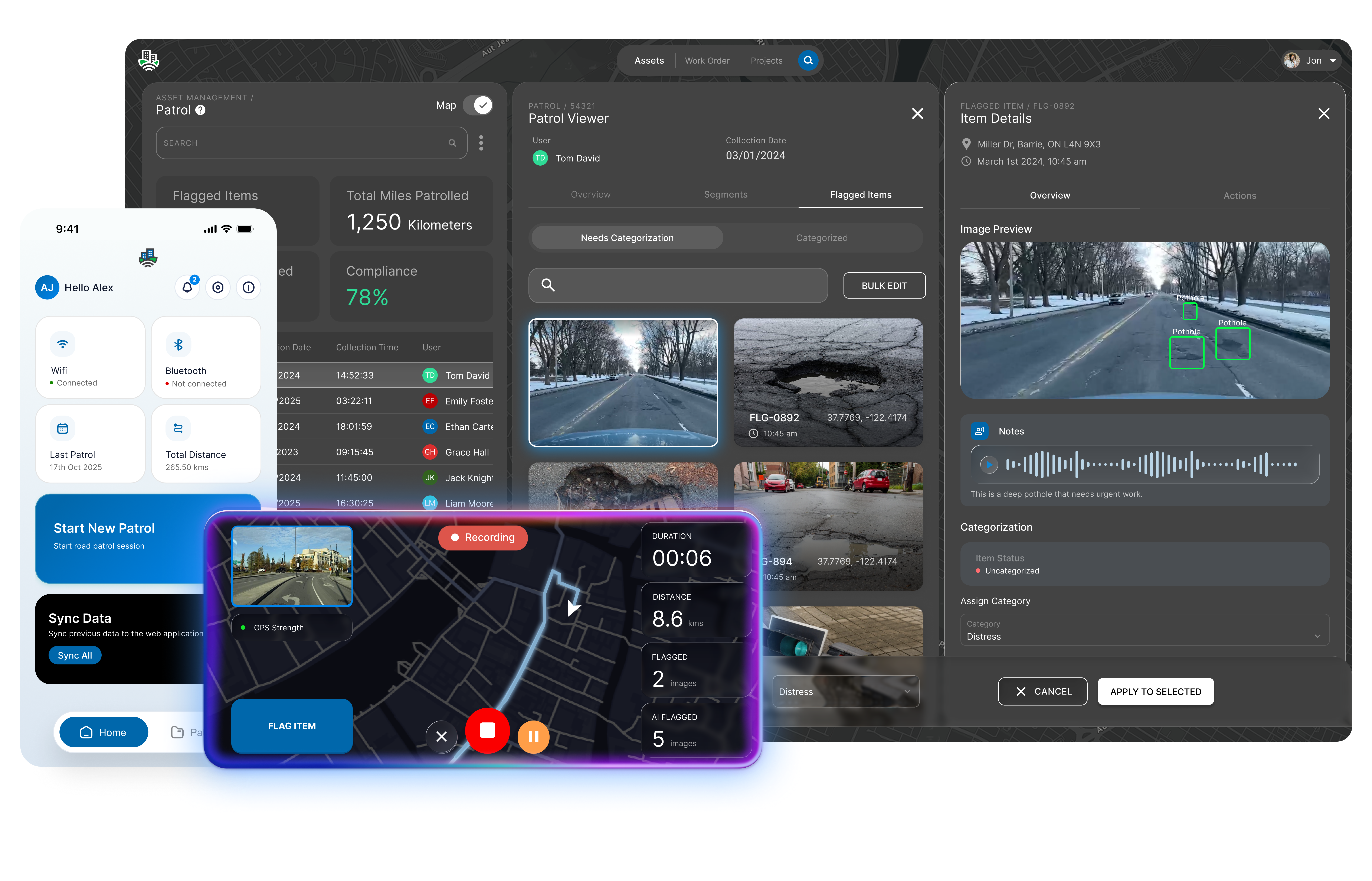
A patrol tool that needs a laptop and a quiet office is useless. The Citylogix Patrol App is purpose-built for Ontario MMS patrol and supercharged by AI, with a single design principle: work happens in the cab, not at the desk.
That means MMS class presets baked in, with alerts before compliance drifts. Winter patrol mode that mirrors the regulation’s weather-triggered requirements. AI models trained on Canadian roads, climate, and marking conventions, not generic US highway footage. Canadian data residency aligned with MFIPPA expectations. Alignment with O. Reg. 588/17 so PCI and asset data feed your Asset Management Plan, not just your MMS binder. And terminology that matches the language in 239/02, not a rebranded pothole app.
Easy in the field
Every interaction is designed for a patroller wearing gloves, in a moving truck, in weather. Large tap targets. Voice-to-text notes. Offline-first operation that syncs automatically on reconnect. Dark mode. One-handed use.
From parking lot to patrol takes under fifteen seconds: mount the phone, auto-pair the Bluetooth button, run windshield/weather/fabric checks, let the app auto-calibrate GPS and the camera mount, and begin recording. If starting a patrol takes five minutes of menus, patrollers skip it. Ours doesn’t.
The Bluetooth wheel button is the deceptively simple piece that changes the whole field experience. One tap to start a shift, and GPS, time, and weather attach automatically. Double tap to drop a geotagged hazard flag the moment debris or a damaged sign comes into view. Hold to talk for a voice-to-text observation note. One tap to end the shift. The patroller never reaches for the phone, never looks down, never writes anything. The patrol record builds itself while they drive. Drivers stay drivers, and the app does the documentation.
Built-in guardrails keep crews from missing what matters. Class-frequency alerts surface when a Class 2 road is drifting toward non-compliance before the deadline passes. Winter triggers fire automatically from weather data. And a routing algorithm proposes patrol routes that help close compliance gaps.
AI-assisted detection
One app feeds two AI workflows.
Patrol AI runs on-device during the shift. It logs potholes, guardrail damage, debris, and signage with GPS, timestamp, and a photo, turning every patrol into an automated asset survey. Each detection lands in the patrol log before the truck is back in the yard, with model version and confidence stored alongside. If a patroller worries the AI missed something, the Bluetooth button is a two-second manual backup.
Cloud AI processes uploaded patrol video and returns a Pavement Condition Index scored segment-by-segment on the industry-standard 0–100 scale. Instead of refreshing your PCI every three to five years, you can refresh it every patrol cycle. That data feeds capital plans, supports O. Reg. 588/17 Asset Management Plan requirements, and gives council a real picture of network health year over year.
The combined effect is concrete. Patrollers stay focused on driving. Work orders open before the truck returns to the yard. Every hazard has a photo and GPS attached without anyone stopping. And the AI doesn’t have bad days or tired eyes; Class 3 roads get the same scrutiny on Tuesday as on Friday.
Reporting and analytics
Supervisors live in one view. Every active patroller on the map. Class-level compliance percentages with drift alerts before the week closes. A flag queue sorted by severity and route. Crew rollups of hours, kilometers, and detections by truck. The Monday-morning question, “are we covered this week?”, gets answered in under ten seconds.
Audit-ready exports take one click: PDF patrol logs formatted for legal intake, CSV exports for discovery, GPS coverage maps that prove the route was patrolled, and AI detection packets with photo, confidence, and model version for every flag. When legal calls at 4:30 on a Friday, you’re done in five minutes, not five days.
Defensible by design
Picture the worked example. An incident on a Class 3 road, Tuesday at 2:14 PM. A notice of claim arrives fourteen months later.
With paper, that’s a week of binder-hunting and hoping nothing’s missing. With the Patrol App: open the system, filter to road and date, and produce the evidence packet in minutes. Patrol log with date, time, patroller, and route. GPS trace proving the truck was on that road. Observation record showing what was seen and what was done. And, often the decisive piece, an AI auto-detection from eleven days earlier, with photo, showing the pothole was already on record and remediation was in progress.
Same evidence that used to take a week, now a signed PDF.
Better records don’t just win claims. They prevent them. Insurer conversations land differently when you can show consistent, tamper-evident records. Claim packets produced in minutes close files faster and reduce legal hours. AI flags hazards before a claim arises, cutting exposure at the source. And some insurers reward documented risk-reduction programs at renewal.
Early outcomes from Ontario municipalities
The numbers from early deployments are encouraging. One hundred percent patrol compliance across four classes within sixty days. Roughly thirty-four hundred hazards auto-detected in the first season across two hundred and forty kilometers. A ninety-seven percent AI field-verification match for potholes, guardrails, and signage. And a ninety percent faster legal response time from records request to packet sent.
As one Director of Public Works put it: “First deployment we’ve had where the patrollers asked for more shifts on the new system.”
Live in a month
Implementation is designed to avoid a heavy IT lift. Week one is setup: routes, classes, cameras. Week two is a single-crew, single-route pilot. Week three trains all patrollers in roughly thirty minutes each. Week four is full deployment with supervisors included. Citylogix configures, you patrol.
Two deployment models are available depending on program shape. Scan-on-Demand reserves a Pelican-cased kit when you’re ready for an annual or biennial PCI and patrol capture, with a dedicated CSM guiding setup, collection, and upload. Always-On keeps the kit in the truck year-round for unlimited routine MMS patrol, with metered PCI assessments triggered on demand to protect data quality.
Where to start
LAS and Citylogix are offering Ontario municipalities a practical first step: a free thirty-minute MMS and AI Patrol Readiness Review built specifically around O. Reg. 239/02, patrol defensibility, and the realities of public works operations.
This is not a generic software demo. It is a focused review of how your current patrol process would hold up under a claim, an FOI request, staff turnover, or a budget discussion. In thirty minutes, Citylogix will help map your existing patrol workflow against the regulation, identify the biggest documentation and defensibility gaps, and outline where AI-assisted patrol can reduce risk, improve field workflow, and strengthen council reporting.
For public works leaders planning 2027 road, asset management, and technology budgets, now is the right time to engage. A small review this summer can clarify the business case, define a pilot path, and give your team the evidence needed before fall budget decisions begin.
Patrol used to be the work that proved itself only after something went wrong. With AI in the cab and a record that builds itself, it can become one of the most defensible, useful, and budget-relevant programs in your public works department. The opportunity now is to see where your current program stands, what can be improved, and how LAS and Citylogix can help you move from patrol completed to patrol proven.
For more information, follow the link to learn about the LAS Road and Sidewalk Assessment service.